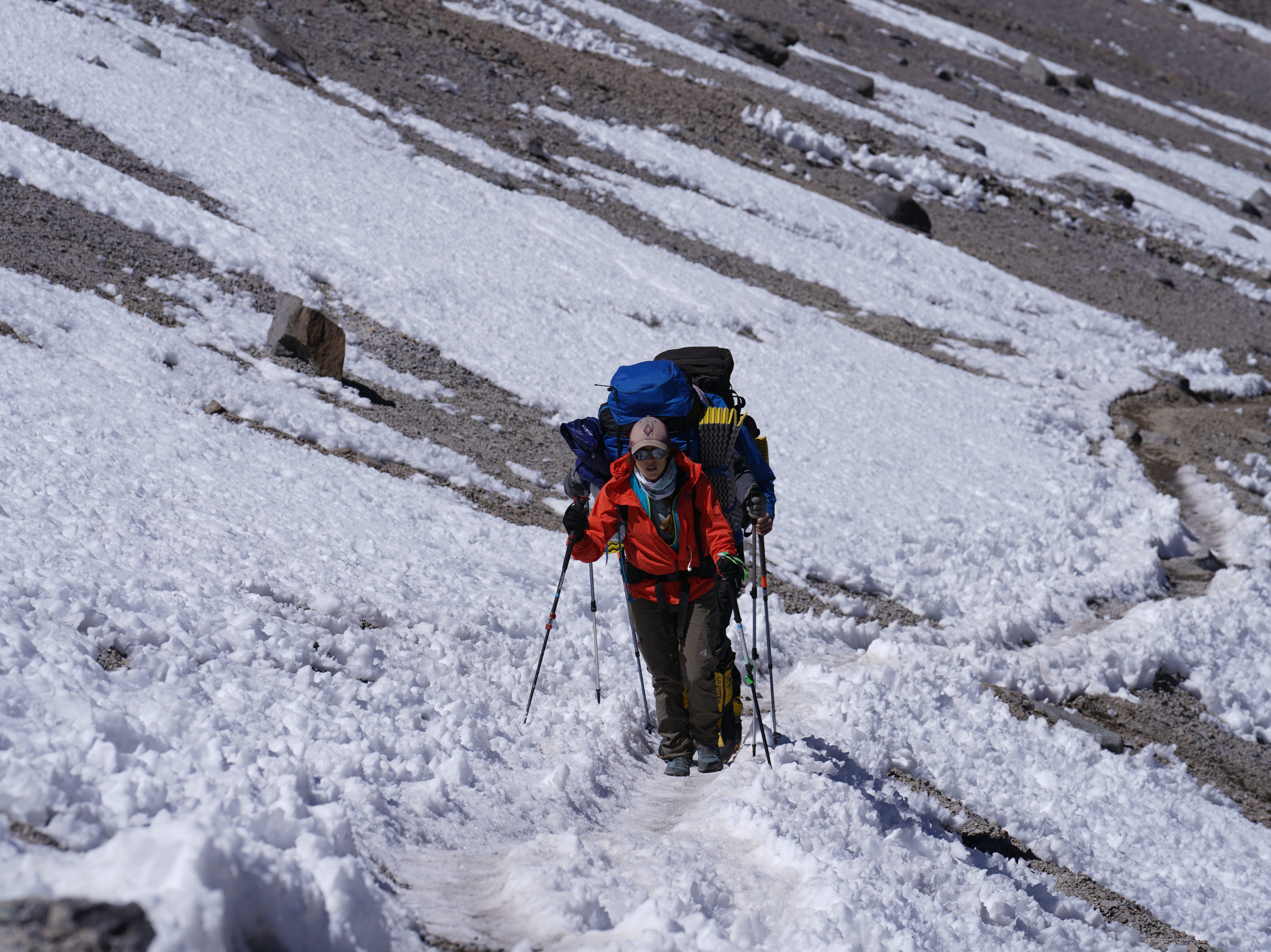
Aconcagua
From $8,500 per Person
Expeditions
Argentina
The Climb
Climb Aconcagua — Guided Normal Route Expedition · 22,841 ft / 6,962 m · 19 Days
Climbing Aconcagua is one of the world's great high-altitude objectives. At 22,841 ft / 6,962 m, it is the highest mountain in South America, the highest peak outside of Asia, and one of the Seven Summits.
The Normal Route is called non-technical, but never underestimate this mountain. Altitude, severe weather, and some of the strongest winds in the Andes make it a real expedition. Aconcagua has a high non-summit rate for reasons that are easy to underestimate: altitude, wind, cold, illness, pacing and preparation. Our program is built around the factors we can influence — acclimatization, team size, guide attention, weather flexibility and honest decision-making.
Built by the Benegas Brothers
Every detail of this expedition — itinerary, acclimatization, pacing and operating standards — reflects experience Willie and Damian Benegas began building on Aconcagua with their first successful ascent together in the 1988–89 season. Between them, the brothers have stood on the summit of Aconcagua more than 100 times.
Today the expedition is delivered by the professional BBE guide team, operating to the standard the brothers built the company on. Private expeditions can be personally led by Willie or Damian when confirmed in the written trip terms.
The Benegas Acclimatization Protocol
Our biggest advantage is a pre-acclimatization phase in Las Cuevas, high on the Argentine–Chilean border — a step almost no other commercial Aconcagua program includes.
Most expeditions drive to the park gate and start walking. We don't. Before entering the park, our teams spend four days based in Las Cuevas at 10,500 ft, including a night camped at 12,800 ft, climbing to nearly 14,500 ft and sleeping progressively higher, so real adaptation starts before the expedition clock does.
The physiology is well established: more nights at altitude before going high means better performance, faster recovery, and lower risk of acute mountain sickness — the leading cause of failed summit bids and evacuations on this mountain. By the time our climbers reach Plaza de Mulas Base Camp (14,300 ft / 4,350 m), they are already adapted to an altitude most teams are only beginning to process.
We also use these days for gear checks, hydration and nutrition, and to learn how each climber moves and responds to altitude — information that shapes how we lead the entire climb.
Certified Aconcagua Guides
This program is built and managed to IFMGA standards — the highest internationally recognized benchmark in the guiding profession. Our expeditions are led by certified professional mountain guides — IFMGA, AMGA (American Mountain Guides Association), and the Argentine Association of Mountain Guides — with experience across the Himalaya, the Andes, the Alaska Range, and Patagonia.
Our job isn't just to walk you to the top. It's to help you become a stronger, more capable mountaineer — on Aconcagua and every mountain after it.
Small Teams: Maximum 6 Climbers
Guide structure scales with team size.
We cap this expedition at six climbers. For one to three clients, the operating model uses one guide. For teams of four to six, a second guide joins at Plaza de Mulas for the upper-mountain climbing portion. Base-camp staff support the expedition but are not counted as climbing guides.
Small teams move efficiently, acclimatize more evenly, and get real guide attention every day — not just at camp. On summit day in the Canaleta, team size is the difference between moving at your pace and waiting in the cold at someone else's. You will never disappear into the group. That is our promise, and the team size exists to keep it.
If you are comparing operators, compare team size, guide certification, and the acclimatization schedule. Those answers will tell you more than any price list.
Safety and Logistics
Safety on a peak of nearly 7,000 meters is a system, not a slogan. Every BBE Aconcagua expedition carries:
- Emergency oxygen on the upper mountain
- Full expedition medical kit and guides trained in high-altitude field medicine
- Satellite and radio communications at all times
- Starlink internet at Base Camp — enough to message home and pull current weather data
- Daily monitoring of every climber: pace, oxygen saturation, hydration, appetite, recovery
Logistics are handled the same way: transportation from Mendoza, permits, mules for heavy equipment, porter support for group gear, and full Base Camp organization at Plaza de Mulas. Good systems conserve energy — and conserved energy climbs mountains.
Summit Strategy
No one can promise you a summit on Aconcagua — be wary of anyone who does. What we offer is a strategy built to maximize your chances: real pre-acclimatization, a small team, certified leadership, personalized pacing, built-in standby days, and careful reading of weather windows.
Our priority is always the climber's health and honest judgment. On this mountain, turning around at the right moment is a professional decision, not a failure.
Who This Expedition Is For
This expedition fits motivated climbers preparing for the Seven Summits, building altitude experience for Himalayan objectives, or pursuing a defining personal goal. It's a strong fit for:
- Experienced trekkers ready for real high-altitude mountaineering
- Climbers who have done Kilimanjaro or high-altitude treks and want a bigger objective
- First-time expedition climbers who want to learn from a professional team
- Mountaineers who value a small-team environment over a mass-market program
Excellent cardiovascular fitness is essential, and prior trekking or altitude experience is strongly recommended. See the Is This For Me? tab for an honest look at what this climb demands.
Ready to Climb Aconcagua?
Aconcagua is a test of discipline, patience, and humility — for many climbers, the biggest thing they've ever done. We don't simply guide expeditions. We help people build a lifetime in the mountains.
Every climber is personally reviewed before booking — we make sure this is the right expedition for you, and that you're ready for it.
Aconcagua Itinerary: 19 Days, Day by Day
Aconcagua Normal Route · 19 Days · 6,962 m / 22,841 ft
You arrive in Mendoza with the mountain you have prepared for finally close enough to feel real. Over 19 days, the expedition changes gradually — city, mountain lodge, tents. Roads become trails, and life is reduced to the essentials: steady movement, warm clothing, food, water, recovery and good decisions.
The itinerary is carefully designed but not rigid. Weather, wind, health, park medical controls and the condition of the team may change the plan — that flexibility is part of climbing a mountain this high responsibly. All distances, elevations and times below are approximate.
Day 1 — Arrive in Mendoza
Elevation: approximately 750 m / 2,460 ft
Activity: arrival, orientation and equipment review
Overnight: Mendoza hotel · welcome dinner included
A member of the BBE team meets you at the airport. The team gathers, reviews the route and acclimatization plan, and your guide checks the equipment that will matter once you are far from Mendoza — the time to fix small problems before they become serious ones higher up.
BBE completes the climbing-permit process (the fee is paid separately, per the instructions sent before arrival), and the team shares a welcome dinner. The expedition has started.
Day 2 — Mendoza to Las Cuevas
Sleeping altitude: Las Cuevas, approximately 3,200 m / 10,500 ft
Driving: approximately 190 km / 118 mi · 3–4 hours
Activity: short acclimatization walk
Overnight: mountain lodging in Las Cuevas
The road follows the Mendoza River west toward the Argentine–Chilean border — each hour the air cooler, the vegetation thinner, the peaks larger. In Las Cuevas you are already sleeping above 3,000 meters.
A short afternoon walk starts the BBE acclimatization process. Your guide begins watching pace, breathing, hydration and recovery. From here on, altitude is part of every decision.
Day 3 — Acclimatization Climb Above Las Cuevas
Maximum altitude: up to approximately 4,200 m / 13,780 ft
Hiking time: approximately 5–7 hours · daypack
Overnight: mountain lodging in Las Cuevas
You climb into the mountains surrounding Las Cuevas; the exact route depends on weather, snow and the team. The day is as much about observation as elevation — your guide watches how you pace, drink and recover, and you begin learning the steady rhythm that will carry you through the expedition.
There is no prize for reaching the high point first. Climb well, return with energy, let the body adapt.
Day 4 — Move to the Acclimatization Camp
Sleeping altitude: approximately 3,900 m / 12,800 ft
Hiking time: approximately 4–6 hours
Pack: overnight equipment plus an assigned share of group gear — up to approximately 20 kg / 44 lb
Overnight: mountain tents
You leave the lodge and begin living as an expedition team. At camp everyone has a role — tents secured, sleeping systems organized, water prepared.
It is your first night in a tent near 4,000 meters, and the habits you establish here follow you onto Aconcagua.
Day 5 — Climb Higher and Return to Las Cuevas
Maximum altitude: approximately 4,300–4,420 m / 14,100–14,500 ft
Hiking time: approximately 5–7 hours
Overnight: mountain lodging in Las Cuevas
After breaking camp, the team continues toward a higher ridge or nearby summit — the high point depends on conditions and how everyone responded to the night. You climb high enough to create another acclimatization stimulus, then descend to Las Cuevas while the team is still moving well.
Tomorrow, you enter Aconcagua Provincial Park.
Day 6 — Horcones to Confluencia
Camp altitude: Confluencia, approximately 3,414 m / 11,200 ft
Distance: approximately 7.5 km / 4.7 mi · 3–4 hours
Pack: daypack — mules carry designated approach loads
Medical control: first required park medical check
Overnight: Confluencia Camp
The road ends and the expedition begins on foot. From the park entrance at Horcones, the trail follows the valley toward Confluencia — with your first clear view of Aconcagua's south face along the way.
At camp you complete the first required park medical check, while your BBE guide continues a separate assessment of how you are moving, eating and recovering.
Day 7 — Confluencia to Plaza de Mulas
Camp altitude: Plaza de Mulas, 4,350 m / 14,300 ft
Distance: approximately 17–19 km / 10.5–12 mi · 7–9 hours
Pack: daypack — mules carry designated approach loads
Overnight: Plaza de Mulas Base Camp
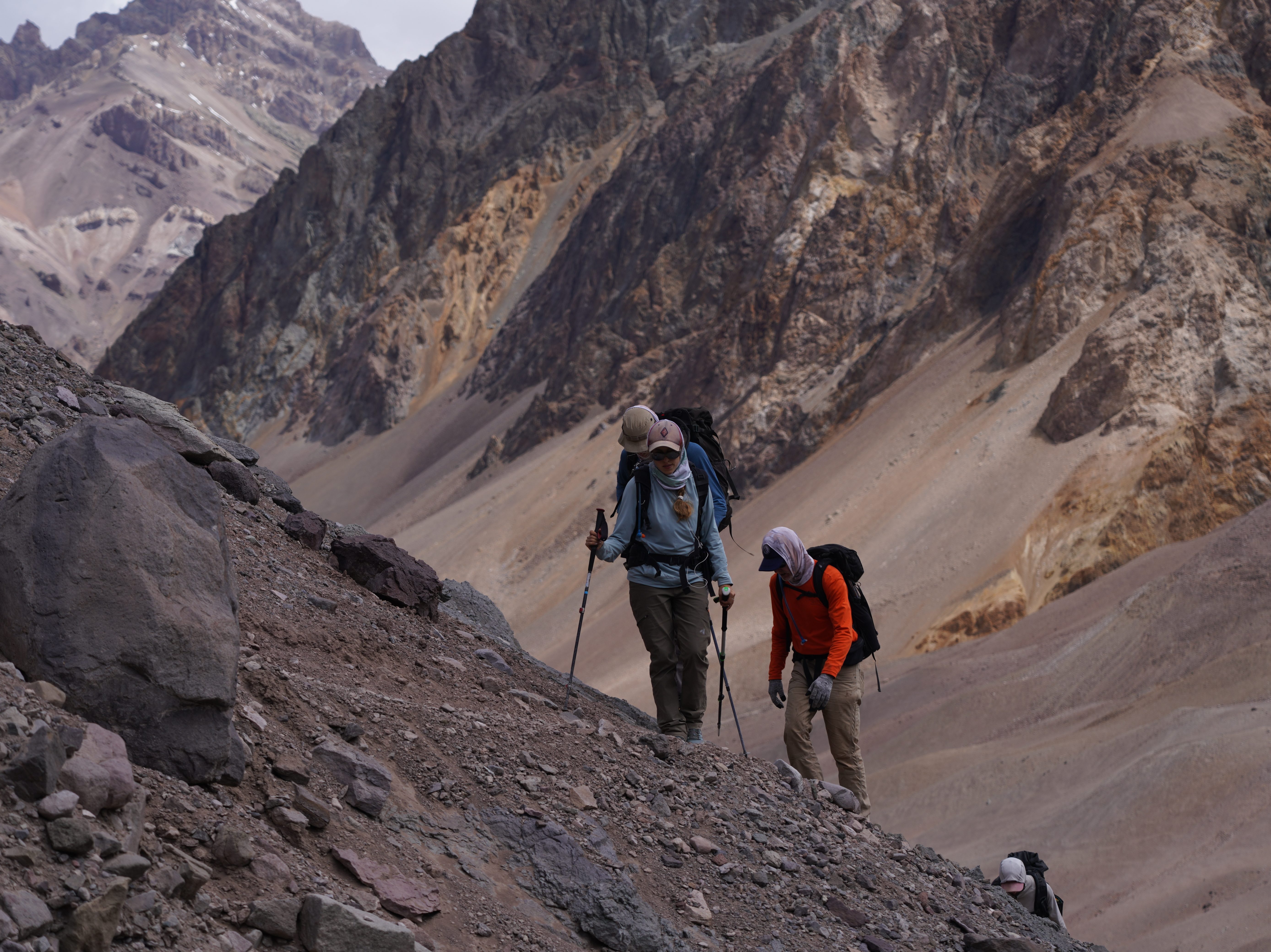
The longest day of the approach. You cross Playa Ancha, a wide, exposed plain where distance is hard to judge. The terrain is not technical, but distance, altitude, sun and wind make the day demanding — and the work done in Las Cuevas shows its value.
By late afternoon, the tents of Plaza de Mulas appear beneath Aconcagua's west face. From here, every camp lies above you.
Day 8 — Rest, Medical Control and Preparation
Altitude: Plaza de Mulas, 4,350 m / 14,300 ft
Medical control: second required park medical check
Overnight: Plaza de Mulas Base Camp
A recovery day, but not an empty one: eat, hydrate, dry clothing, absorb the approach. You complete the second park medical check — clearance is required, but your guide also weighs symptoms, appetite, sleep and recovery.
The team reduces the big duffels to true upper-mountain equipment. The next time you leave base camp, you are climbing the mountain itself.
Day 9 — Carry to Camp Canadá
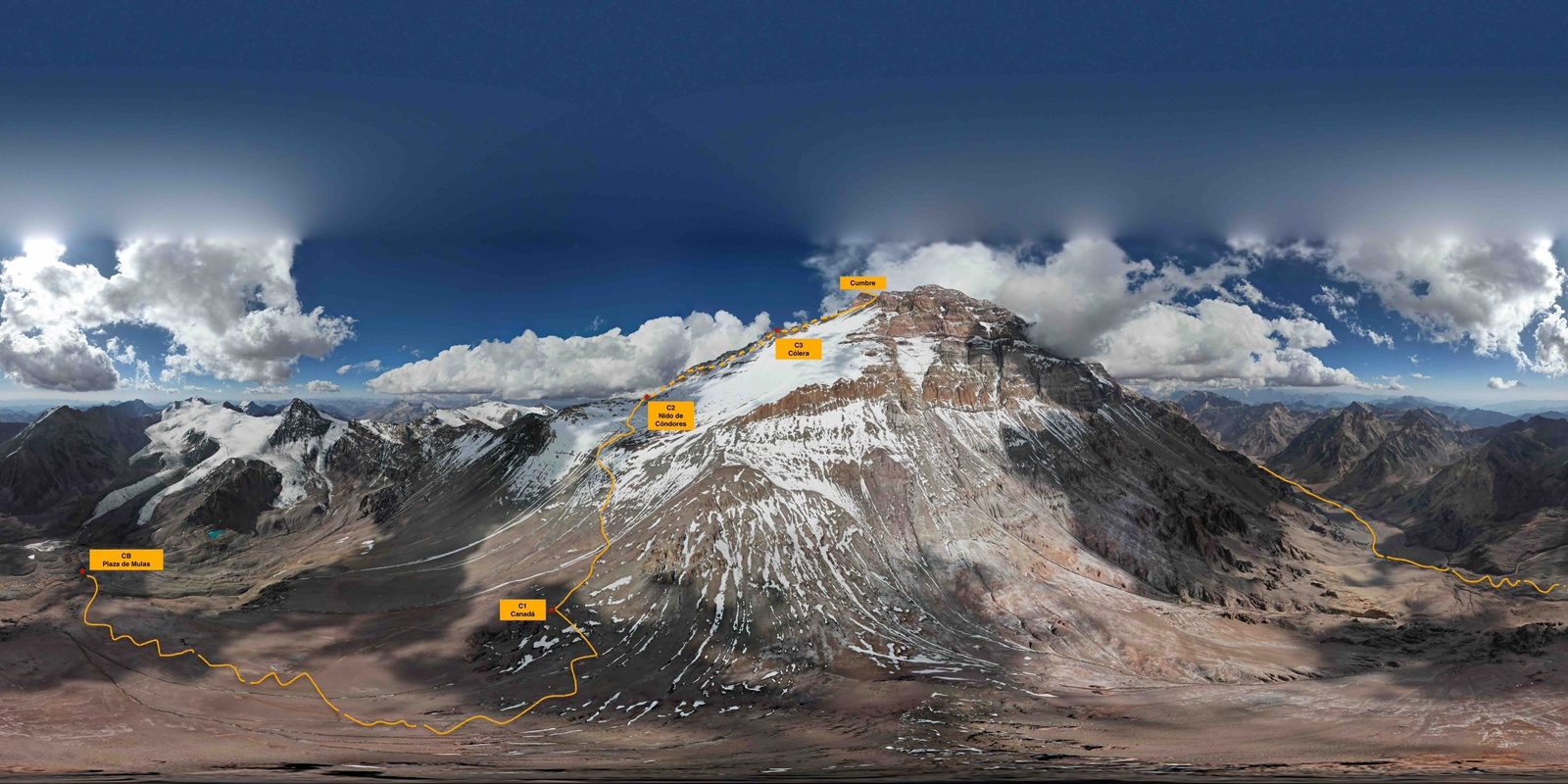
Maximum altitude: Camp Canadá, 5,050 m / 16,570 ft
Hiking time: approximately 5–7 hours · load up to approximately 20 kg / 44 lb
Sleep: Plaza de Mulas Base Camp
You step onto the upper mountain, carrying food, fuel and equipment up steep, loose terrain to establish a cache at Camp Canadá, then return to sleep in thicker air.
Gaining 700 meters at this altitude takes patience — and gives your body another controlled exposure above 5,000 meters.
Day 10 — Move to Camp Canadá
Sleeping altitude: Camp Canadá, 5,050 m / 16,570 ft
Hiking time: approximately 3–5 hours · load up to approximately 20 kg / 44 lb
Overnight: Camp Canadá
This time you do not turn back. Your guide sets a controlled pace, watching for small changes in breathing, coordination or energy.
At Canadá the team builds its home on the mountain — tents anchored, water melted, an early, quiet evening. You are now living above 5,000 meters.
Day 11 — Carry to Nido de Cóndores
Maximum altitude: Nido de Cóndores, 5,550 m / 18,210 ft
Hiking time: approximately 5–7 hours · load up to approximately 20 kg / 44 lb
Sleep: Camp Canadá
You climb broad, open slopes toward Nido de Cóndores, where wind is often a constant companion. Nido sits on a wide plateau — an endless horizon on a clear day, severe on a windy one.
You cache equipment and descend to sleep at Canadá. The system is making sense: climb, prepare, descend, eat, sleep, repeat.
Day 12 — Move to Nido de Cóndores
Sleeping altitude: Nido de Cóndores, 5,550 m / 18,210 ft
Hiking time: approximately 4–5 hours · load up to approximately 20 kg / 44 lb
Overnight: Nido de Cóndores
You climb back to the cache with a heavier load — and this time you stay. At Nido the exposure is immediate: wind against the tents, every camp task slower.
The team focuses on fundamentals — water, food, warmth, rest — and communicates honestly about condition. The summit feels close, but it is still a long way above.
Day 13 — Move to Cólera Camp
Sleeping altitude: Cólera Camp, 6,000 m / 19,685 ft
Hiking time: approximately 3–4 hours · load up to approximately 20 kg / 44 lb
Overnight: Cólera Camp
Short on a map, demanding in practice. Cólera sits on a broad shelf where the summit route finally becomes real — you can see the terrain toward Independencia and the traverse below the summit ridge.
Camp work is efficient: tent, clothing, water for the night and the summit attempt. Your guide reviews weather, departure time and turnaround expectations. The final decision to climb depends on health, wind, temperature and conditions.
Day 14 — Summit Attempt
Maximum altitude: Aconcagua summit, 6,962 m / 22,841 ft
Round-trip time: approximately 10–13 hours · summit pack
Overnight: Cólera Camp, unless the guide changes the descent plan
You wake in darkness and leave under headlamps at a deliberately slow pace — there is no warm-up at 6,000 meters. The route climbs past Piedras Blancas toward Independencia, then the long traverse across the upper mountain, where wind and cold can be severe. The Canaleta is the final steep section; above it, the route gains the Guanaco ridge and follows the edge of the immense south face to the summit.
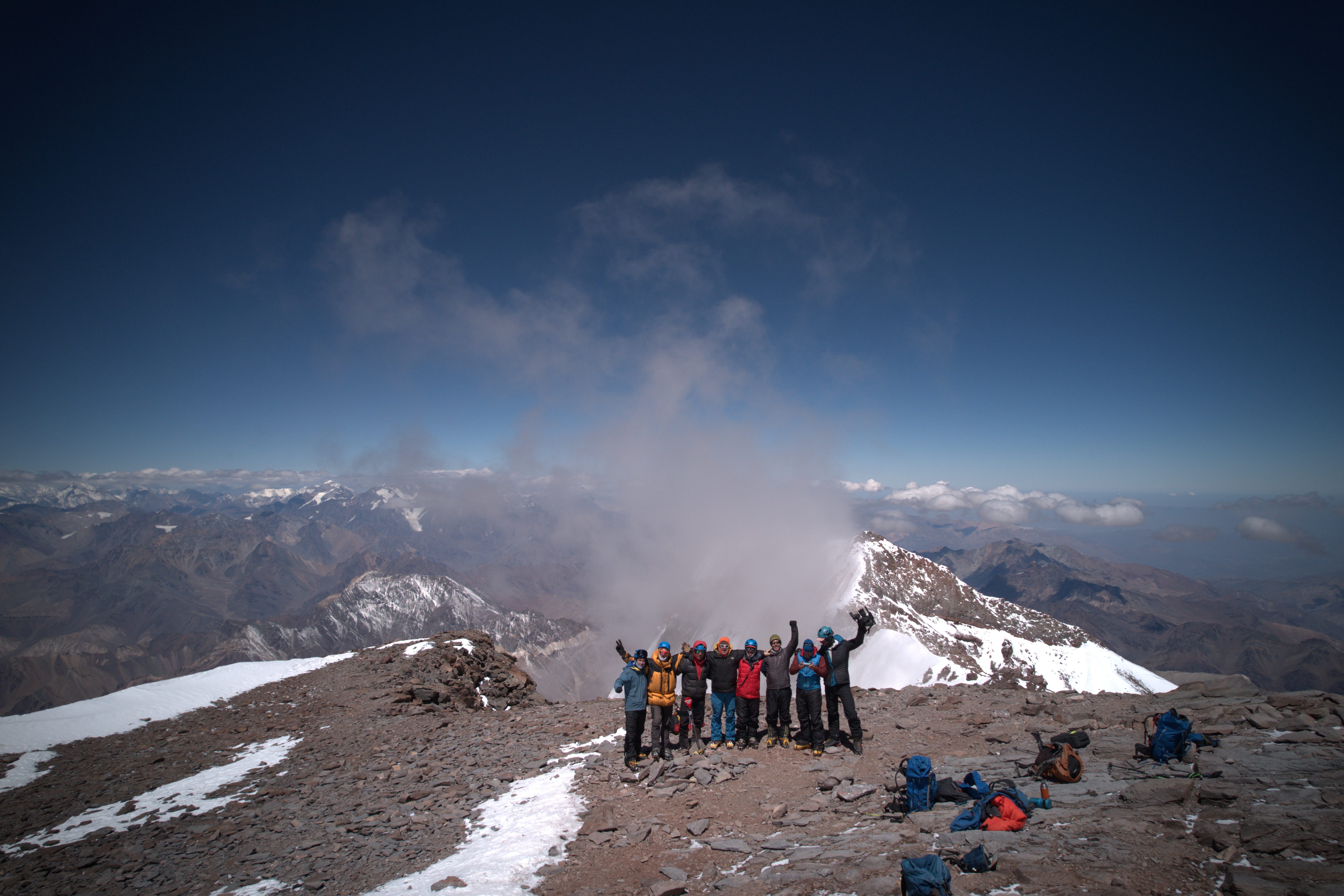
When conditions, timing and health allow, you step onto the highest point in the Americas. It is not the end of the day — you still have to descend safely to high camp.
A summit is never guaranteed. Your guide may turn you or the team around for pace, symptoms, weather or time. That decision is not failure; it is responsible high-altitude climbing.
Days 15–16 — Weather and Flexibility
Activity: weather hold, rest, summit attempt or descent
Overnight: determined by the guide team
These days stay flexible: waiting for lower winds, recovering before an attempt, or beginning the descent after an earlier climb. Waiting is one of the hardest parts of an expedition — and where experienced leadership matters most.
The guide team weighs wind, temperature, timing, snow, health and the ability to descend safely. Flexibility creates options, not guarantees.
Day 17 — Descend to Plaza de Mulas
Ending altitude: Plaza de Mulas, 4,350 m / 14,300 ft
Hiking time: approximately 5–7 hours
Overnight: Plaza de Mulas Base Camp
The long descent to base camp, passing Nido de Cóndores and Camp Canadá to collect caches. With every few hundred meters the air feels thicker, and base camp feels like another world — chairs, full meals, room to spread out.
Whether or not the summit was reached, the team has spent days living and deciding at serious altitude. That experience belongs to everyone who returns.
Day 18 — Trek Out and Return to Mendoza
Distance: approximately 24 km / 15 mi · 7–9 hours, then 3–4 hours driving
Pack: daypack — mules carry designated expedition loads
Overnight: Mendoza hotel
The final mountain day begins early: back down the Horcones Valley, across Playa Ancha, out at the park entrance and into the vehicle for Mendoza.
The transition is sudden — hours later you are among trees and warm evening air, with a shower and a real bed waiting.
Day 19 — Departure
Activity: breakfast, hotel checkout and independent airport transfer
Airport transfer: not included — departure times vary; BBE can help you arrange one
You share breakfast, say goodbye to the team and arrange your onward travel.
Some people leave with a summit. Others leave with hard-earned experience and a different relationship with the mountains. Most carry both.
Good to Know
Meals. The Day 1 welcome dinner is included. All other included meals follow the final itinerary — the trip documents show exactly where meals are included and where to budget separately.
Pack weights. On upper-mountain days, prepare to carry approximately 20 kg / 44 lb. Porter support may sometimes reduce loads, but it is not guaranteed unless included in your confirmed expedition plan.
Your role. Clients are active members of the team: carrying assigned loads, helping in camp, following pacing and hydration plans, communicating symptoms honestly, and accepting turnaround decisions. Aconcagua is not a service delivered around you — it is an expedition you participate in.
The numbers. Everything here is a planning estimate, not a promise. Your guide adjusts the schedule, camps and summit day when conditions require it. That flexibility is part of the design.
Continue Preparing
Read next: the Is This For Me?, Dates and Prices, What to Budget For and Before You Go tabs.
Questions about the itinerary or your readiness?
How Hard Is Aconcagua?
Aconcagua Normal Route · An Honest Assessment
Aconcagua is often described as a non-technical mountain, and that description causes more failed expeditions than the mountain itself. No, you will not need ropes on the Normal Route. Yes, it will be one of the hardest things you have ever done.
This is the conversation we would have with you before booking — honest, specific and without sales pressure. Read it carefully. If you finish it more motivated than intimidated, that tells you something useful.
What Makes Aconcagua Hard
Not the climbing. The living. For nearly three weeks you will walk long days, carry real loads, sleep progressively higher and function in deepening cold with less and less oxygen. The difficulty comes from:
- Altitude — you will sleep above 5,000 m / 16,400 ft for multiple nights and spend summit day near 7,000 m, where every step takes deliberate effort
- Cold and wind — summit day can bring temperatures far below freezing with severe wind chill, and Aconcagua's winds are among the strongest in the Andes
- Long days — 7–9 hours on the biggest approach day and 10–13 hours round-trip on summit day
- Load carrying — on upper-mountain days, plan to carry up to approximately 20 kg / 44 lb
- Patience — weather holds are normal; you may spend days waiting for a summit window, and waiting well is a skill
Aconcagua turns back many strong climbers. Altitude, wind, illness, pacing and preparation all matter, and no guide service can remove those variables. What a well-designed expedition can do is improve the things within our control: acclimatization, fitness preparation, team size, pacing, flexibility and decision-making.
The Fitness Required
Excellent cardiovascular endurance is essential. This is the single most controllable factor in how your expedition goes.
You should be able to hike 7–9 hours with a moderate pack and get up the next day able to do it again — repeated over many days. You should be comfortable carrying around 20 kg on steep, loose terrain, and you should arrive with a fitness reserve, because altitude will take a share of everything you have.
Most successful climbers train seriously for at least four to six months: long weighted-pack hill days, back-to-back big days on weekends, and consistent aerobic base work. If you contact us early, we can help you assess where you are and what your preparation should focus on.
The Experience Required
The Normal Route requires no technical climbing, and no prior use of ropes. What matters is mountain experience: multi-day trips, life in a tent, managing your own clothing, food and hydration through changing weather.
The strongest preparation is previous altitude experience — a trek or climb above 4,000–5,000 m such as Kilimanjaro, a high Andean trek or a comparable objective. It teaches you the one thing training at home cannot: how your own body behaves at altitude.
Depending on the season and snow conditions, the upper mountain can require crampons and an ice axe. You do not need prior experience with them — our guides teach the basics on the mountain — but you should arrive fit enough to move steadily while wearing them. Contact us for the full equipment list.
Motivated climbers on their first major expedition can succeed here. What we look for in that case is exceptional fitness, genuine commitment to preparation, and the humility to learn fast. Every climber's background is personally reviewed before booking, and we will tell you honestly if we think a different objective should come first.
Who Does Well on Aconcagua
After three decades on this mountain, the pattern is clear. The climbers who reach the summit — and enjoy the expedition — are not always the strongest athletes. They are the ones who:
- Pace themselves with discipline instead of racing the group
- Eat, drink and rest deliberately, even when they don't feel like it
- Communicate honestly about how they are feeling, early
- Work as team members — helping in camp, watching out for others
- Accept the guide's decisions, including the hard ones
If that sounds like how you already operate in the mountains — or how you want to learn to operate — you will fit this team.
Be Honest With Yourself About This
This expedition is probably not the right fit if you need a guaranteed summit to consider the trip worthwhile, if your schedule cannot absorb serious training between now and departure, or if waiting out a storm at base camp sounds intolerable rather than simply hard.
None of those make you unfit for the mountains — they make this particular objective, right now, the wrong tool for what you want.
Turning around can be the correct professional decision on Aconcagua, and our guides make it when conditions or health require. Climbers who join us understanding that come home stronger — very often with the summit as well.
Where This Climb Fits
For some climbers, Aconcagua is the defining objective — the biggest mountain they will ever attempt. For others, it is preparation: the standard altitude test before the Himalaya, or one of the Seven Summits. Both climbers belong on this team, and both get the same attention. Experience is individual, and there is no ladder you are supposed to be on.
Not Sure? That's Normal
Most of our climbers were not sure when they first wrote to us. The honest answer to "could I actually do this?" usually starts with a conversation — about your experience, your fitness, your timeline and what you want from the mountains.
Every climber we guide is personally reviewed before booking. We would rather help you choose the right mountain than sell you the wrong one.
Read next: the Day by Day, Dates and Prices and Before You Go tabs, and the FAQ below.
Dates and Prices
Aconcagua Normal Route · 19 Days · 2026–27 Season
This section explains the dates, price, services, guide staffing and booking terms for the Benegas Brothers Aconcagua Normal Route expedition.
Aconcagua rises to 6,962 m / 22,841 ft. The Normal Route does not usually involve sustained technical climbing, but the altitude, weather, cold and length of the expedition make it a serious mountaineering objective.
Before accepting a registration, BBE reviews each client's experience, fitness and preparation. The goal is to determine whether Aconcagua is the right objective and what work may still be needed before departure.
2026–27 Expedition Dates
November 29 – December 17, 2026 — Open
January 9–27, 2027 — Open
February 6–24, 2027 — Open
Availability may change. A place is confirmed only after BBE has accepted the client's application and received the required deposit.
Expedition Price
$8,500 USD per client
The scheduled expedition price is based on shared accommodations where applicable. A single-room supplement may be available in Mendoza for an additional cost. Private expeditions and custom departures are quoted separately.
What the Price Supports
This is a complete 19-day expedition, not only guiding on the upper mountain. The price supports:
- Pre-trip preparation and equipment guidance
- Four days of staged acclimatization in the Las Cuevas area
- A structured progression through Confluencia, Plaza de Mulas and the upper camps
- BBE expedition leadership and guide support
- Scheduled transportation from arrival through the end of the expedition (departure airport transfer not included)
- Mendoza hotels and Las Cuevas lodging
- Mountain tents and camp systems
- Mule transport for designated expedition loads
- Full service at Plaza de Mulas Base Camp
- Upper-mountain support according to the team size and operating plan
- Group technical and safety equipment
- Medical and communication systems
- Aconcagua permit processing
These systems allow clients to focus their energy on acclimatization, climbing, recovery and responsible participation in the expedition.
Team Size and Guide Staffing
All scheduled public Aconcagua departures are capped at six clients. Scheduled departures operate with a minimum of three clients.
The climbing-guide structure is:
- One to three clients: one guide
- Four to six clients: one lead guide, with an assistant guide joining at Plaza de Mulas Base Camp to support the team on the upper mountain
During the approach trek, the guide structure is based on one guide for up to three clients. The additional guide for teams of four to six joins at base camp for the climbing portion above Plaza de Mulas.
Plaza de Mulas also has a full local service staff, which may include camp managers, cooks and other support personnel. Base-camp staff provide camp services but are not counted as climbing guides.
Every expedition is led by an internationally or nationally certified guide selected according to BBE standards and supported by the appropriate local team.
Registration does not guarantee that Willie or Damian Benegas will personally guide the departure unless their participation is specifically confirmed in writing.
Included
Pre-Trip Support
- Client application and readiness review
- Pre-trip planning and communication
- Training recommendations
- Personal equipment consultation
- Equipment review in Mendoza
- Expedition information and preparation documents
Transportation and Logistics
- Scheduled airport pickup in Mendoza
- Ground transportation required by the itinerary
- Transfers between Mendoza, Las Cuevas and Aconcagua Provincial Park
- Permit paperwork and processing
- Mule transport for designated equipment and expedition loads
- Upper-mountain support for designated group loads according to the operating plan
Accommodations
- Two scheduled hotel nights in Mendoza
- Park Hyatt Mendoza or a comparable approved hotel
- Lodging during the Las Cuevas acclimatization phase
- Mountain tents and scheduled camp accommodations
Hotel substitutions may be necessary because of availability or operational requirements. Any replacement will be selected to provide a comparable standard.
Meals
- Meals specifically listed in the final itinerary
- Meals during the Las Cuevas acclimatization phase
- Meals during the scheduled mountain program
- Full meal service at Plaza de Mulas Base Camp
Expedition Operations
- BBE expedition leadership
- Certified climbing-guide team
- Full local base-camp services
- Local operational support
- Group tents and camp systems
- Group cooking equipment and fuel
- Designated group technical equipment
- Expedition medical kit
- Radio or satellite communication systems appropriate to the expedition
- Emergency equipment carried according to the operating plan
Not Included
- International or domestic airfare
- Aconcagua Provincial Park climbing permit fee
- Passport, visa or entry expenses
- Excess-baggage charges
- Personal clothing and mountaineering equipment
- Equipment rentals
- Rescue and medical evacuation insurance
- Trip cancellation and interruption insurance
- Personal porter services beyond the support specifically listed as included
- Guide and staff gratuities
- Personal snacks, drinks and summit food
- Showers, internet, beverages and other personal base-camp purchases
- Meals in Mendoza that are not listed in the itinerary
- Additional hotel nights caused by early arrival, delayed departure or itinerary changes
- Unscheduled transportation or lodging
- Medical treatment, evacuation or repatriation
- Expenses resulting from weather, illness, flight disruptions, government action or other circumstances outside BBE's control
- Additional mountain or base-camp days beyond those included in the itinerary
Aconcagua Climbing Permit
The Aconcagua Provincial Park climbing permit is not included in the BBE expedition price. BBE handles the permit paperwork and processing for each client as part of the expedition service. The client remains responsible for paying the permit fee separately.
For the 2026–27 season the Normal Route permit is $1,285 USD.
The permit must be paid before entering Aconcagua Provincial Park. Plan to pay in cash, in United States dollars, after arriving in Mendoza, following the instructions provided by BBE. Permit payments are non-refundable.
The Government of Mendoza determines permit prices and procedures, and the season band is based on your actual date of entry into the park. Fees may vary by season, nationality, route and service category, and BBE confirms the current amount and payment instructions before departure. Do not rely on permit prices from previous seasons when preparing your final budget.
Insurance Requirements
Rescue and medical evacuation coverage is required. The policy must explicitly cover:
- High-altitude mountaineering up to at least 7,000 meters
- Climbing Aconcagua in Argentina
- Helicopter or other emergency evacuation when medically necessary
- Emergency medical treatment
- International medical transport
- Repatriation
Comprehensive travel insurance covering cancellation, interruption, delays and baggage is strongly recommended.
Insurance must be purchased before the deadlines stated in the booking documents. BBE must receive proof of the required coverage before departure.
Contact us with any insurance questions before you buy a policy.
Deposit and Final Payment
A deposit equal to 20% of the expedition price is required to reserve a place.
For an expedition price of $8,500:
- Required deposit: $1,700
- Fixed non-refundable booking fee: $850
- Remaining balance: due 120 days before departure
The booking fee covers planning, reservations, administration and financial commitments made to operate the expedition.
Registrations made within 120 days of departure require full payment at booking.
Payment Methods
Bank wire is the recommended payment method. The sender is responsible for all bank charges — the full invoiced amount must arrive in the BBE account after sending-bank, intermediary-bank and receiving-bank fees.
US checking account. Payment through the invoice system may be available for a flat $25 platform fee.
Credit or debit card. US-issued cards, 3% processing fee. International cards, 4% processing fee. Processing fees are added to the invoice total.
Cancellation Policy
All cancellations must be submitted in writing.
- 121 days or more — payments refunded less the fixed booking fee and any unrecoverable costs already incurred
- 91–120 days — 50% of payments beyond the booking fee are refunded
- 61–90 days — 25% of payments beyond the booking fee are refunded
- 60 days or less — no refund
Unrecoverable costs may include hotels, staff commitments, local-operator deposits, transportation, and other reservations or services secured for the expedition.
Transferring payments to another BBE program may sometimes be possible, but it is not guaranteed.
Refunds are not issued for:
- Illness or injury
- Altitude illness
- Insufficient fitness, preparation or technical readiness
- Missed or delayed flights
- Passport, visa or entry problems
- Voluntary withdrawal
- Removal because of unsafe conduct
- Failure to pass the required park medical controls
- Weather or mountain conditions
- Route or park closures
- Government restrictions
- Failure to reach the summit
- Other circumstances outside BBE's reasonable control
The complete BBE International Programs Policy is provided during registration. That policy controls if there is any conflict with this summary.
Additional Base-Camp Days
The expedition price includes Plaza de Mulas Base Camp services only for the days listed in the itinerary. The local operating agency charges BBE for each additional day the team remains at base camp. Additional days may be required because of weather, client or team circumstances, itinerary changes, or other conditions outside the scheduled program.
The current charge is $240 USD per client, per additional day, covering the base-camp services provided for that day.
Additional guide staffing, porter services, transportation, hotels or other logistical expenses may be charged separately when required.
The itinerary includes flexibility days, but these cannot cover every possible delay.
Private and Custom Aconcagua Expeditions
Private expeditions are available for clients who want a dedicated team, different dates, or a program designed around specific needs. Private formats may be appropriate for individual climbers, couples, families, groups of friends, clubs or organizations, clients who need different dates, climbers who prefer a different pace, teams requesting additional acclimatization, climbers seeking increased porter support, and clients preparing for a future high-altitude objective.
Private expeditions are priced according to the dates, group size, guide staffing, porter support and final logistical plan.
Participation by Willie or Damian is available only when specifically confirmed in the written proposal.
Contact us for a private proposal.
Before You Register
Review the following pages before applying:
- The Climb
- Day by Day
- Is This For Me?
- What to Budget For
- Before You Go
Aconcagua should not be selected only because the dates and price work. It must also be the right objective for your experience, preparation and long-term goals in the mountains.
Ask a Guide
Tell us about your climbing background, altitude experience, recent training, and what you hope to gain from Aconcagua. We will give you a direct assessment of whether the expedition is a good fit and what preparation may still be needed.
Ready to Register?
Once you are ready to move forward, use the BOOK TRIP button on this page to submit your application and expedition deposit.
What to Budget For
Aconcagua Normal Route · The Complete Cost Picture
Aconcagua is genuinely difficult to budget. The expedition fee is one number — see the Dates and Prices tab for that, and for departures and booking terms. The real cost of the trip is another, and the gap catches climbers off guard. This section lays out every cost category beyond the fee so you can plan accurately and arrive in Mendoza without financial stress.
We publish every category below because climbers who budget accurately climb with a clearer head, and because transparency is how we do business.
What Your Expedition Fee Includes
The core program from arrival in Mendoza through the end of the expedition: all scheduled ground transportation including airport pickup; Mendoza hotel nights and the Las Cuevas refuge stay per the itinerary; expedition meals as listed, with full meal service at Plaza de Mulas; expedition tents and camp systems at all camps; mule transport for designated loads; upper-mountain support for designated group loads according to the operating plan; a certified guide team on every departure with an assistant guide joining at base camp for teams of four to six; satellite communications, a comprehensive expedition medical kit and emergency oxygen on the upper mountain.
The complete inclusion list is in the Dates and Prices tab.
What Is Not Included — Plan for These
Park permit — $1,285. The 2026–27 Normal Route fee, paid in cash (USD) in Mendoza and non-refundable. Fees are set by Mendoza Province each season and the season band is based on your actual date of entry into the park. We confirm the current rate in your pre-departure packet.
International flights — you book these yourself. Round-trip to Mendoza (MDZ), typically via Buenos Aires or Santiago. Cost depends entirely on where you fly from and when you book, so we don't publish a figure. Book 4 to 6 months ahead, and check baggage allowances before you buy: expedition gear is heavy, and the domestic Argentina leg enforces low economy limits (around 15 kg). Pre-pay extra bags where possible. See the Before You Go tab for routing guidance.
Personal gear — depends on what you already own. Ask us for the full gear list, and talk to us before you buy anything.
Rescue & Medical Evacuation Insurance — Required
Mandatory on all BBE Aconcagua expeditions; proof is required before your permit is issued. Your policy must explicitly cover helicopter evacuation from high altitude and international medical transport.
Global Rescue is the industry standard — note that Aconcagua requires their High-Altitude Evacuation Package on top of the base membership. Recent combined pricing has run approximately $850–900; confirm current rates directly with the provider. Ripcord Rescue Travel is a solid per-trip alternative — request a quote for your dates.
Do not rely on standard travel insurance: most policies cap altitude or exclude mountaineering entirely.
Trip Cancellation & Travel Insurance — Strongly Recommended
Separate from evacuation coverage: flight disruptions, cancellation, missed connections, baggage, travel medical. Typically $200 to $500. Carry both — they are different products.
Tips
Guide team — about $900, typically $600 to $1,200 per climber for the full expedition, shared equally among every guide on your team.
Base camp staff, porters and muleteers — $60 to $80 per climber.
Optional, standard in the industry, and meaningful to the people who take care of you.
Extra Days at Base Camp — $240 per person, per day
The itinerary includes four scheduled days at Plaza de Mulas, and the base camp operation charges per person per day. If weather, itinerary changes or personal circumstances require additional days at base camp beyond the schedule, the charge is $240 per person per day, covering your meals, tent and camp services.
We tell you this here — not at base camp — so it is in your buffer, not a surprise.
Optional Costs Worth Planning For
Porter support — up to about $1,310 for full service. Hired locally through the guide team, per carry: $218 to Camp Canadá, $316 to Nido de Cóndores, $388 to Cólera, $388 back down to Plaza de Mulas. High value on carry days — your guides advise honestly based on how you are moving.
Extra Mendoza hotel nights — $100 to $250 per night. Many climbers decompress a night or two after the mountain.
Phone — $50 to $100. Carrier add-on or a local SIM in Mendoza, which is the cheaper option for the full trip.
Personal snacks — $50 to $100, bought in Mendoza.
Base camp extras — $50 to $150: showers ($5–10 per use), Wi-Fi, camp store.
Emergency Evacuation — Know the Numbers
Helicopter evacuation, when weather permits, has recently run about $2,300 for one climber, less per person shared. Ground evacuation, medical-delay hotel nights and support beyond the scheduled itinerary are also the climber's responsibility.
This is the entire argument for the mandatory insurance above — an emergency descent should be a medical event, not a financial one.
Cash & Currency
USD cash is required for the permit and preferred on the mountain. Cards work normally in Mendoza for hotels, restaurants and shopping; at base camp some services accept cards but the base camp operator may add a fee of up to 7%, so cash is cheaper there.
Argentina's exchange situation shifts quickly — current guidance comes in your pre-departure packet.
Budget Summary
Beyond the expedition fee, your flights and your gear, typical ranges in USD:
Park permit — $1,285 · cash in Mendoza, required
Rescue and evacuation insurance — $500 to $900 · mandatory
Trip insurance — $200 to $500 · strongly recommended
Tips, guides and staff — $660 to $1,280
Porter support, optional — up to $1,310 · high value on carry days
Snacks, phone and base camp extras — $150 to $350
For the expedition fee itself, see the Dates and Prices tab.
Cash to carry: $2,100 to $2,900 USD, covering the permit, tips, base camp extras and personal spending. Add up to approximately $1,310 if you plan to use full porter service. There are no banking services above Mendoza, so bring it with you rather than planning to withdraw it.
Questions About Costs or What's Included?
Preparing for Aconcagua: Before You Go
Aconcagua Normal Route · Your Preparation Roadmap
The climbers who arrive in Mendoza relaxed are the ones who handled the paperwork months ago, not weeks. This section puts everything in order — what to do when, and where to find the details. Handle it early, and your energy in the final weeks goes into training, not logistics.
Aconcagua at a Glance
Summit — 22,841 ft / 6,962 m
Length — 19 days, airport to airport
Season — Late November through February
Fly into — Mendoza, Argentina (MDZ)
What makes it hard — High altitude, wind, cold and camping. Not technical climbing.
Handle These Early
Park permit — $1,285. Paid in US dollar cash, in Mendoza, before entering the park. Not included in your trip fee.
Insurance — mandatory. Must cover high-altitude mountaineering and helicopter evacuation.
Cash — $2,100 to $2,900. Argentina runs on cash more than most climbers expect.
What's in This Section
Each topic below answers one question. The timeline further down tells you when each one matters.
Permits, Visas & Required Insurance
Argentina is visa-free for most nationalities on a short stay, so the paperwork that actually takes time is the insurance. Your policy must cover high-altitude mountaineering and helicopter evacuation, and proof is checked at the permit office in Mendoza before you enter the park. BBE handles the permit process; you bring the cash.
Flights & Getting to Mendoza
Most climbers route through Santiago or Buenos Aires into Mendoza (MDZ). Arrive early on Day 1 — a member of the BBE team meets you at the airport, and orientation is that evening. Departure can be any time on Day 19. Wait until your departure is confirmed as guaranteed (minimum three clients) before buying tickets.
Where You Sleep: Hotels, Camps & Refuges
Two nights in Mendoza at the Park Hyatt or similar, double occupancy with a single supplement usually available. Then the refuge at Las Cuevas during pre-acclimatization, Plaza de Mulas base camp at 14,300 ft, and the high camps above: Canadá at 16,570 ft, Nido de Cóndores at 18,210 ft, Cólera at 19,685 ft.
Aconcagua Gear List
How to think about your kit as systems rather than a shopping list — sleep, hands, feet, layers. Ask us for the complete item-by-item list. Start early. Boots and a sleeping bag this cold need real training days to test, and anything you plan to rent should be reserved at least three weeks out.
A Day on the Mountain
The rhythm of carry days and rest days, what you eat, how you sleep at altitude, and why silence from the upper mountain is normal. Starlink is live in base camp — shared, and dependent on power and weather. Showers at Plaza de Mulas can be purchased.
Cash, Extra Costs & Tipping
Argentina runs on cash more than most climbers expect, and the $1,285 permit alone is a significant US dollar payment you make in person. Plan to carry cash for the permit, tips for the guide team and base camp staff, porter carries if you use them, and a sensible buffer. See the What to Budget For tab.
Private & Custom Expeditions
Different dates, your own team, or one-to-one guiding. A small number of Founder-Led departures run each season; when a founder leads a departure, it is confirmed in the written trip terms.
Your Preparation Timeline
When You Book
- Submit your Trip Application & Medical History Form, liability waiver, emergency contacts and passport copy — all provided by BBE at booking
- Check your passport: valid at least 6 months beyond your return date
- Start structured training — see the Is This For Me? tab for what to build toward
- Read the gear list now, so big purchases have time to be tested
3–5 Months Before
- Book flights to Mendoza (MDZ) — confirm your departure is guaranteed before purchasing, and consider refundable fares
- Purchase rescue and medical evacuation insurance. It must cover high-altitude mountaineering and helicopter evacuation
- Reserve any rental gear
- Break in boots and test your layering system on real training days
6–8 Weeks Before
- Send BBE your flight itinerary and insurance certificate
- Confirm entry requirements — most nationalities, including US, Canadian, EU and UK citizens, enter Argentina visa-free for stays under 90 days
- Complete the permit application form so BBE can process your climbing permit in Mendoza
The Final 2 Weeks
- Do a full pack-out using the gear list — every item, packed the way it will travel
- Arrange the cash you will carry. The $1,285 permit is paid in US dollar cash in Mendoza, on top of tips and personal expenses
- Taper training. Arrive rested, not exhausted
- Make digital copies of your passport, insurance certificate and permits — phone and cloud
Arrival Day
A member of the BBE team meets you at Mendoza airport. That evening the team gathers for orientation, the first gear check and a welcome dinner — and the expedition begins. From that point on, logistics are our job. Yours is climbing.
Still Deciding?
This section assumes you are going. If you are still working out whether Aconcagua is the right objective this season — fitness, prior altitude, what happens if you turn around — that is a different conversation, and we have written it out honestly.
See the Is This For Me? tab and the FAQ below.
Questions While You Prepare?
Preparation questions are exactly what we are here for — gear choices, training doubts, insurance fine print, flight timing. Ask early; small questions are easiest to solve months out.
Pricing (per person)
Pricing is a typical estimate, final quote will be provided after receiving your inquiry.